
Almond Protein Market to Reach USD 5.97 Billion by 2035, Driven by Plant-Based Nutrition and Wellness Trends
Almond Protein Market is gaining momentum as demand rises for plant-based nutrition, clean-label foods, convenient
Press Release Disclaimer: This is a press release distributed through the XPR Media network. It has not been independently verified by our newsroom.
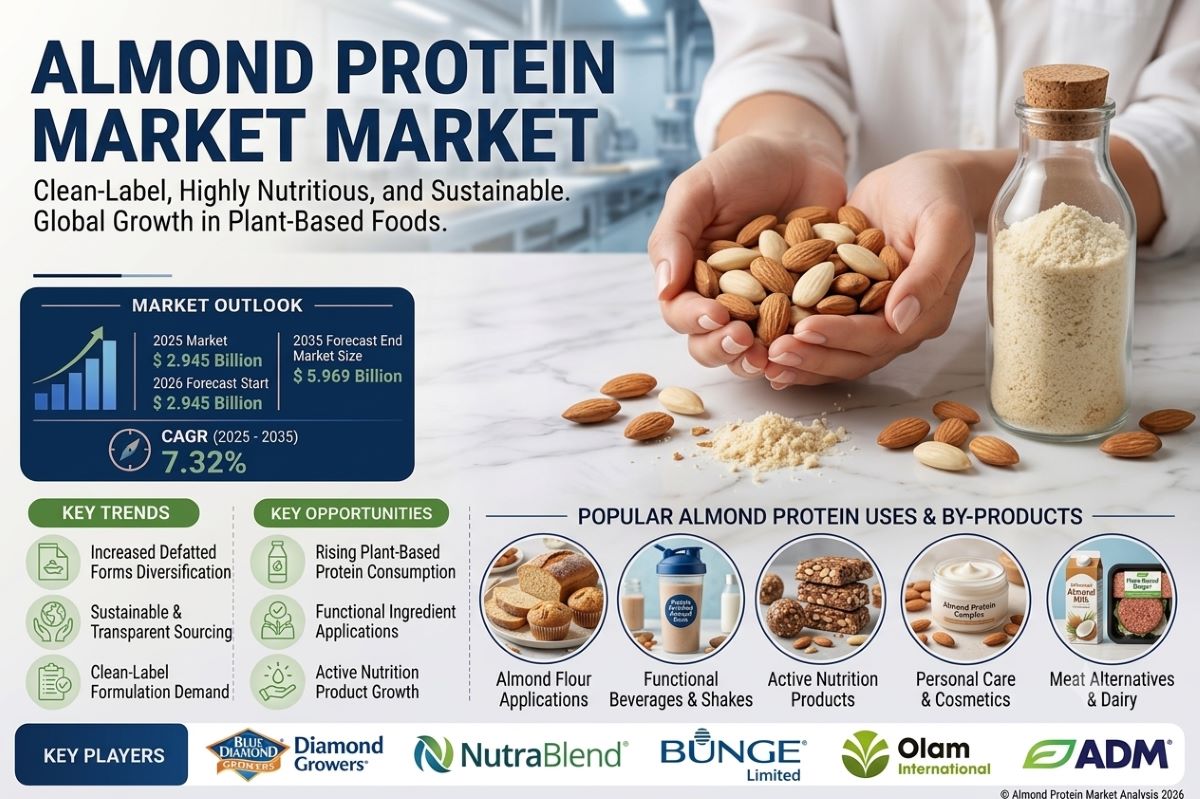

Almond Protein Market is gaining momentum as demand rises for plant-based nutrition, clean-label foods, convenient protein products & healthier dietary choices.
NEW YORK, NY, UNITED STATES, August 24, 2026 /EINPresswire.com/ — Almond Protein Market Overview:
The global Almond Protein Market Size is entering a period of sustained expansion as consumers increasingly seek protein ingredients that align with plant-forward diets, wellness goals, and evolving food preferences. Almonds have traditionally been recognized as a nutrient-rich food, but advancements in food processing and ingredient technology are creating new opportunities to use almond-derived protein across beverages, nutrition products, bakery products, snacks, and other food applications. This transition is strengthening the role of almond protein as an ingredient rather than limiting almonds to conventional whole-nut consumption.
The market was valued at approximately USD 2.744 billion in 2024 and is expected to reach USD 2.945 billion in 2025. By 2035, the industry is anticipated to reach nearly USD 5.969 billion, reflecting a CAGR of 7.32% between 2025 and 2035. This expansion demonstrates the growing commercial importance of plant-based protein ingredients and the increasing willingness of food manufacturers to explore differentiated protein solutions.
Changing Consumer Preferences Strengthen Demand:
One of the most important factors influencing the Almond Protein Market is the rapid evolution of consumer dietary preferences. Plant-based eating has moved beyond a niche lifestyle category and is increasingly represented across mainstream grocery, sports nutrition, foodservice, and functional food products. Consumers may choose plant-based protein for several reasons, including dietary preferences, perceived nutritional benefits, sustainability considerations, and interest in experimenting with alternative ingredients.
The growing popularity of vegetarian and flexitarian diets is particularly relevant. Flexitarian consumers may not completely eliminate animal products but often seek opportunities to increase their intake of plant-based foods. This creates a broad potential customer base for food products containing alternative protein ingredients.
Almond protein can also benefit from the popularity of almond-based foods and beverages. Almond milk, almond snacks, nut-based spreads, and other almond products have already established familiarity among consumers. This existing awareness can make almond-derived protein ingredients easier for manufacturers to incorporate into products targeted toward health-conscious audiences.
Product Innovation Creates New Opportunities:
Innovation is becoming a central element of competition in the Almond Protein Market. Food manufacturers are not simply increasing the quantity of plant-based protein in products; they are also focusing on taste, texture, functionality, formulation stability, nutritional performance, and convenience.
Advances in ingredient processing can help manufacturers develop almond protein ingredients suitable for different product categories. Protein powders and concentrates can be incorporated into nutritional beverages, smoothies, meal replacements, sports nutrition products, and dietary formulations. In bakery and snack applications, almond protein can contribute to the development of protein-enriched products designed to meet changing consumer expectations.
Innovation is also expanding the possibilities for convenient nutrition. Consumers increasingly want foods that fit into busy schedules without compromising their nutritional objectives. Ready-to-drink beverages, protein bars, instant nutrition products, and convenient snack formats therefore represent important areas of opportunity.
The future competitive landscape is likely to place greater emphasis on formulation capabilities. Companies that can successfully balance nutritional value, sensory quality, affordability, shelf stability, and consumer appeal may gain stronger positions in emerging application categories.
Almond Protein in Sports and Active Nutrition:
Sports and active nutrition represents another promising area for almond protein. Consumers involved in fitness, recreational sports, and active lifestyles are increasingly interested in convenient protein sources that can complement their dietary routines.
Protein beverages, powders, snack bars, and meal-support products have become common components of active nutrition. While conventional protein sources continue to dominate many formulations, plant-based alternatives are receiving increased attention as consumers seek broader choices.
Almond protein can provide manufacturers with an ingredient option for developing plant-focused sports nutrition products. Its application may extend beyond traditional bodybuilding-oriented products toward everyday wellness beverages and snacks consumed by individuals who simply want to increase their protein intake.
This widening definition of active nutrition is significant for market development. Protein products are increasingly marketed toward broader consumer groups, including professionals, students, travelers, and consumers seeking convenient nutrition. As this audience expands, opportunities for plant-derived protein ingredients can increase accordingly.
Get Full PDF Sample Copy of Report: (Including Full TOC, List of Tables & Figures, Chart) @
https://www.marketresearchfuture.com/sample_request/31719
Application Landscape Expands Across Food Categories:
The application landscape of the Almond Protein Market is diverse, reflecting the flexibility of protein ingredients in modern food manufacturing. Product developers are exploring applications across beverages, bakery products, confectionery, snacks, nutritional formulations, and other food categories.
Beverages are particularly important because liquid nutrition products offer convenient consumption and allow manufacturers to combine protein with other functional ingredients. Almond protein can potentially be incorporated into smoothies, nutrition drinks, plant-based beverages, and specialized formulations.
Bakery applications provide another avenue for expansion. Protein-enriched breads, cookies, muffins, and other baked products are gaining attention as consumers look for ways to incorporate additional protein into familiar foods. Almond protein can support product developers seeking to create differentiated nutritional profiles while maintaining consumer-friendly formats.
Snack foods also offer considerable potential. Protein bars, bites, crackers, and other convenient snacks are increasingly positioned around nutrition and satiety. The incorporation of almond protein may help manufacturers develop products that combine convenience with plant-based positioning.
Source and Product Form Influence Market Development:
Product form is an important consideration for manufacturers because different applications require different ingredient characteristics. Almond protein may be supplied in forms designed for incorporation into dry mixes, beverages, nutritional formulations, and processed foods.
Powder-based formats are particularly relevant to applications where ingredients need to be blended with other dry or liquid components. Their convenience in storage, transportation, and formulation can support wider adoption among food and beverage producers.
Source characteristics also influence purchasing decisions. Manufacturers are increasingly examining ingredient quality, processing methods, nutritional composition, consistency, and supply reliability. As the industry becomes more sophisticated, suppliers may need to provide greater transparency and technical support to meet the formulation requirements of commercial customers.
This focus on ingredient performance is likely to increase competition among suppliers. Companies that can deliver consistent quality while supporting product development and formulation optimization may strengthen relationships with food manufacturers.
Distribution Channels Support Market Accessibility:
Distribution plays an important role in determining how almond protein reaches commercial and consumer markets. Business-to-business supply networks remain important because food manufacturers require ingredients in reliable quantities and specifications. Ingredient suppliers, distributors, processors, and food companies therefore form an interconnected value chain.
At the consumer level, online retail is also creating additional accessibility for protein powders and nutrition products. Digital commerce allows consumers to compare products, review ingredient information, and purchase specialized nutrition products without relying exclusively on physical retail outlets.
Specialty health stores and conventional supermarkets remain relevant as well. As plant-based nutrition becomes more mainstream, almond protein products may increasingly appear alongside other functional foods and nutritional products.
The interaction between physical and digital distribution is likely to become more important over the forecast period. Manufacturers may increasingly use online platforms not only as sales channels but also as tools for educating consumers about ingredient characteristics and product applications.
Regional Market Outlook:
The Almond Protein Market is being shaped by demand trends across North America, Europe, Asia-Pacific, South America, and the Middle East and Africa. Each region presents a distinct combination of consumer preferences, food manufacturing capabilities, dietary trends, and retail structures.
North America is an important environment for plant-based protein innovation due to established consumer interest in functional nutrition, alternative diets, sports nutrition, and convenient food products. The region’s developed food processing industry also provides opportunities for manufacturers to experiment with new protein formulations and applications.
Europe presents strong opportunities as consumers increasingly evaluate food products based on nutrition, ingredients, sustainability, and dietary compatibility. Plant-based foods have gained visibility across European retail markets, creating opportunities for alternative protein ingredients in multiple product categories.
Asia-Pacific offers significant long-term potential because of its large consumer base and evolving food preferences. Urbanization, changing lifestyles, expanding packaged food consumption, and growing awareness of protein nutrition can support demand for innovative plant-based ingredients. Local product development may also create opportunities for almond protein to enter regionally relevant applications.
South America has opportunities linked to expanding food processing activities and increasing consumer interest in nutritional products. Meanwhile, the Middle East and Africa may gradually see stronger adoption as modern retail, food manufacturing, and awareness of alternative protein options continue to develop.
Competitive Landscape:
The Almond Protein Market features food ingredient companies, almond processors, nutrition manufacturers, and specialized suppliers. Key players include:
▪️Blue Diamond Growers
▪️NutraBlend
▪️Bunge Limited
▪️Olam International
▪️ADM
▪️Kerry Group
▪️Sundown Products
▪️The Wonderful Company
▪️Pioneer Foods.
Competition centers on product quality, functionality, innovation, supply capabilities, distribution networks, and customer relationships. Established companies benefit from strong infrastructure and distribution, while specialized suppliers compete through customized solutions and focused product development.
Strategic partnerships are also gaining importance, enabling ingredient suppliers and food manufacturers to develop innovative applications, enhance formulations, and address evolving consumer preferences. R&D collaborations can further support product innovation and expand almond protein applications across food and beverage categories.
Sustainability and Responsible Ingredient Development:
Sustainability is increasingly influencing decisions throughout the food and ingredient industries. Consumers, retailers, and manufacturers are paying greater attention to resource utilization, sourcing practices, production efficiency, packaging, and environmental impact.
For the almond protein segment, sustainability considerations may become increasingly connected to sourcing and processing practices. Companies that demonstrate responsible supply chain management and efficient production processes can potentially strengthen their positioning with environmentally conscious customers.
At the same time, sustainability messaging must be supported by credible sourcing and operational practices. Manufacturers are likely to face increasing expectations for transparency throughout the ingredient supply chain. This could encourage investment in traceability, responsible sourcing programs, production efficiency, and improved resource management.
Key Growth Drivers:
Rising consumer demand for plant-based protein remains one of the strongest growth drivers for the Almond Protein Market. The shift toward flexible dietary patterns is increasing the potential customer base for plant-derived ingredients, while the expansion of functional foods is creating additional application opportunities.
Health and wellness trends are another important factor. Consumers increasingly seek foods that deliver specific nutritional benefits and fit into broader wellness routines. Protein has become a widely recognized component of balanced nutrition, creating opportunities for manufacturers to develop protein-enriched products.
Convenience is also influencing demand. Modern consumers often prefer foods that combine portability, ease of consumption, and nutritional value. This trend supports protein bars, beverages, powders, and ready-to-eat products that can incorporate almond protein.
Product diversification will further contribute to growth. Rather than depending on one application category, manufacturers can target multiple segments, reducing reliance on a single product format and expanding the potential addressable market.
Challenges Facing the Industry:
The Almond Protein Market faces challenges including high ingredient costs, supply fluctuations, processing requirements, and strong competition from soy, pea, rice, oat, and other plant proteins. Suppliers must demonstrate clear advantages through nutrition, taste, functionality, and application versatility.
Raw material availability and price volatility can also affect production costs and profit margins. Agricultural conditions, transportation expenses, and supply chain disruptions may further influence pricing and availability.
Taste and texture are additional considerations, as consumers increasingly expect plant-based products to provide appealing sensory experiences. Manufacturers need effective formulation and processing technologies to improve flavor, texture, and overall product quality. Addressing these challenges through innovation, efficient sourcing, and improved formulations will be important for expanding almond protein adoption across food, beverage, sports nutrition, and functional food applications.
Emerging Trends in Almond Protein:
Several trends are expected to shape the Almond Protein Market during the forecast period. Plant protein is increasingly moving beyond specialized nutrition products into mainstream snacks, bakery items, beverages, and meal solutions. Personalized nutrition is also creating opportunities for products tailored to specific dietary and nutritional needs. Clean-label demand remains important as consumers prefer recognizable ingredients, transparency, and responsible sourcing. In addition, hybrid formulations combining almond protein with other plant proteins or functional ingredients are gaining attention. Such innovations can help manufacturers improve nutritional value, taste, texture, and product performance while meeting evolving consumer preferences. Together, these trends are expected to support broader adoption of almond protein across food, beverage, and nutrition applications.
Future Outlook:
The Almond Protein Market has a positive outlook as demand for plant-based nutrition expands. Growth will be supported by ingredient innovation, changing consumer preferences, sustainability, and wider applications. Almond protein is expected to gain adoption in beverages, sports nutrition, snacks, bakery products, protein powders, and functional foods. Companies focusing on product performance, affordability, sustainable sourcing, and advanced processing can capture emerging opportunities. Continued investment in research, product development, and supply chain capabilities will further support market expansion. As food manufacturers seek versatile plant-based ingredients, almond protein is positioned to become an increasingly important component of the global alternative protein landscape.
Frequently Asked Questions?
1. What is driving the Almond Protein Market?
Rising demand for plant-based protein, health-focused foods, convenient nutrition products, and vegetarian and flexitarian diets is driving the market.
2. What will be the size of the Almond Protein Market by 2035?
The market is projected to reach USD 5.969 billion by 2035, growing at a 7.32% CAGR from 2025 to 2035.
3. Which applications offer opportunities for almond protein?
Key applications include protein powders, nutritional beverages, sports nutrition, snacks, bakery products, and functional foods.
4. Which regions are covered in the Almond Protein Market analysis?
The analysis covers North America, Europe, Asia-Pacific, South America, and the Middle East & Africa.
Discover Related Research Reports By Market Research Future:
Almond Ingredient Market:
https://www.marketresearchfuture.com/reports/almond-ingredient-market-26750
Almond Butter Market:
https://www.marketresearchfuture.com/reports/almond-butter-market-26741
Almond Products Market:
https://www.marketresearchfuture.com/reports/almond-products-market-23307
Almond Flour Market
https://www.marketresearchfuture.com/reports/almond-flour-market-18860
Almond Milk Market:
https://www.marketresearchfuture.com/reports/almond-milk-market-2872
Market Research Future
Market Research Future
+1 855-661-4441
email us here
Legal Disclaimer:
EIN Presswire provides this news content “as is” without warranty of any kind. We do not accept any responsibility or liability
for the accuracy, content, images, videos, licenses, completeness, legality, or reliability of the information contained in this
article. If you have any complaints or copyright issues related to this article, kindly contact the author above.

Media gallery
